SAFETY FOR ELECTRICAL MEDICAL DEVICES AND IEC 60601-1 – Practitioner Training
- Blended course: online course + 2 live virtual classroom sessions
- EU and US requirements
- Beginner - advanced
- Last updated - Apr 2026
During this innovative course, you will build an awareness of effective management of safety throughout the product lifecycle.
Develop and maintain electrical medical devices according to the IEC 60601-1 standard with more confidence after this blended course. You will gain an understanding for basic safety, and how to avoid the most common pitfalls. Learn the theory first during the online course, and then apply that theory during the two live virtual classroom sessions.
Would you like to know a simple proactive approach that will enable you to be in control of safety and requirements throughout all the development phases? During this short course on safety for electrical medical devices and the IEC 60601 series of standards, I'm going to share with you my own proven recipe on how to manage safety simply and effectively. And if you stick around to the end, I will show you my trick on how to make safety engineering fun. I am Claus Rømer. I have worked with regulatory, navigation, medical devices, medical device product development and testing for over 15 years. I am a member of the IEC technical committee 62, authoring the IEC 60601 standards. I love working with development teams, figuring out how to manage safety effectively. And I would like to teach you my approach for working with safety for medical devices. I will be showing you what safety is, the general requirements for safety and how to navigate and apply the standards. You will also be briefed on why it is critical to identify specific requirements before you start the development of your medical devices. The goals of this short course are that you should get an understanding of what basic safety for medical devices is and why you should care about it, and improve your chances of not ending up in projects that are behind schedule and over budget. Based on that, you should be able to figure out if the full course on safety for medical devices that we offer on medicaldevicehq.com could help you in your job or career. The full course is similar to this one, but much more comprehensive, with more in-depth information and quizzes at the end of each topic to test your knowledge and understanding. At the end of the full course, you will also receive a course certificate, which many auditors will be looking for. All manufacturers of medical devices aim to ensure that their products are safe and effective. Also, it is a regulatory requirement for any market where you wish to sell your product. Considering the diversity of medical devices, how they're used and the technologies they employ, this can be challenging. Therefore, standards have been developed to help manufacturers, test houses, and regulators. In this part, I will show you how the standards for electrical medical devices are structured. I will try to do this so you can navigate the standards and identify the relevant requirements without having to read many thousands of pages. All these standards in combination define what is called basic safety and essential performance for different types of devices. I will help you navigate these requirements and find the standards relevant to your product. The general standard relevant for safety for electrical medical devices is IEC 60601-1. This standard specifies general requirements for basic safety and essential performance. The general standard is an umbrella standard based on collateral standards and particular standards. The collateral standards specify general requirements applicable to subgroups of devices, as well as specific characteristics of devices not covered by the general standard. The topics of the collateral standards include electromagnetic compatibility, usability, alarms, closed-loop controllers, home healthcare, and EMS. In principle, each of these collateral standards apply in parallel with the general standard. In addition to the general standard and the collateral standards, we also have particular standards. Each of these apply to a very specific type of product. The particular standards may modify, replace, or delete requirements contained in the general and the collateral standards. As the standards apply to electrical medical devices having an applied part or a patient connection, you can imagine they define requirements for a lot of hazards. Some requirements are more detailed than others. The requirements include electrical requirements, including insulation, leakage current, protective earth. Mechanical requirements include structural integrity, moving parts, patient support systems, noise and vibration. Radiation requirements include X-ray, alpha, beta, gamma, neutron, microwave, and light radiation. Temperature and other hazards include heat, cold, fire, spillage, cleaning, ingress of water and particulate matter. Use-related requirements include usability, home healthcare, alarms, and hazardous outputs. Software requirements for the development process and risk management. Constructional requirements relate to controls, indicators, serviceability, connectors, replacement of components and wiring. Functional requirements are often defined in particular standards and in some of the collateral standards. All these requirements and other hazards relevant to your device need to be identified and managed through the risk management process. See our course on risk management at medicaldevicehq.com to find out more about risk management in particular. So if your medical device falls within the scope of the 60601-1, you are going to have to pay attention to all these requirements and reach at least the levels defined in the standards. Because if you don't, not only do you risk injuring people, but you're also likely to not meet the legal requirements for placing your product on the market. The goal with all of this is to ensure basic safety and essential performance, which basically means that patients and other users shall have freedom from unacceptable risk. Remember, the goal was to get an understanding of what basic safety for medical devices is. Let's start with the definition of only safety, which comes from ISO 14971. Safety is defined as freedom from unacceptable risk. What is then basic safety? Basic safety is to avoid unacceptable risk directly caused by physical hazards when medical electrical equipment is used under normal condition and single fault condition. As you can tell, this is a slightly more narrow concept compared to safety in general. And this is the definition of essential performance, which has the same objective to avoid unacceptable risk. Now, if you only have one takeaway from this course, let it be this: Freedom from unacceptable risk is achieved through proactive risk management, requirement management, and verification during all development phases and thereafter. To establish that the device is safe, you should manage all risks relevant for electrical medical devices. Let's now talk about where most manufacturers fail to address safety by design and how you can proactively avoid making the same mistakes. This will help you develop safe medical devices in an effective and efficient way. In my experience, the most common problem manufacturers face is the lack of proactive management of these many requirements. Many manufacturers won't spend any significant time on the requirements from 60601-1 until they have sent the medical device to third-party testing and discover that they did not meet one or several requirements. And some of these things you can do yourself to save time and money. This will be discussed further in the full course. Typically, safety-related activities are performed late in the design verification phase or even as late as the design validation phase. This results in failed tests, redesign, and retesting, which add cost and delays. To avoid costly delays, I recommend that you identify the few relevant requirements early during the design phase and decide how the design is going to meet these requirements. As I referred to in the beginning, the key to proactive safety by design is to start early and, based on the intended purpose and technologies, identify which standards are applicable to your device and identify which of the hazards and requirements are applicable to your device. Then document in design notes how the product is designed to be safe. It is critical to do this as a cross-functional team exercise, because it is the combination of electronic, mechanic, and software solutions that must meet the requirements. Remember, risk management should be a team effort and safety is a system property. In the beginning, I promised you I would share my trick to make safety engineering fun. To be honest, it's very simple. I always try to be curious and start by asking questions rather than finding solutions. I do this to identify the few features which are critical to the product, and then I focus on these. Next, I ask all stakeholders for their input. This includes team members, management, suppliers, and so on. I also consult standards and guidelines to ensure I understand all aspects of the requirements. When I have clarified what the key requirements are, and I have analysed the ways they can be managed, then and only then is it time to identify and document solutions. So, to state it simply, my trick is to focus on clarification and analysis before execution. This makes safety engineering much easier and way more fun. So, by now, I hope you have a better understanding of what safety for medical devices and 60601 is all about. I also hope you have been inspired by my approach to proactive safety by design. These topics and many more will be elaborated further in the full course. Thank you for watching this short course. If you want to learn more about safety for medical devices, I welcome you to sign up for the full online course Introduction to Safety for Medical Devices and IEC 60601, where I will take you through more details and teach you how to proactively integrate the requirements in your design control process. At Medical Device HQ, we offer online courses, public training classroom courses, as well as in-house training on safety, risk management, design control, and project management for medical devices. Drop us a line on support@medicaldevicehq.com if you would like to learn more about your options or receive a proposal. I hope to hear from you.
2 Live classroom sessions + Templates
€ 1099/ seat
| Course length | approx. 16-32 hours (25 CPD points) |
| Next classroom sessions |
TBC, 2026 |
Select your course plan
ONLINE
€ 449
Average completion time 9-25 hours
Total video duration 4.5 hours
CPD points 18
Number of quizzes 41
Final exam
Course certificate
Ask the instructor
6 months access to the course and instructor
Digital course companion
ONLINE LIFETIME
€ 549
Average completion time 9-25 hours
Total video duration 4.5 hours\
CPD points 18
Number of quizzes 41
Final exam
Course certificate
Ask the instructor
Lifetime access to the course and instructor
Digital course companion
BLENDED
YOU ARE HERE
€ 1099
Average completion time 16-32 hours
Total video duration 4.5 hours
CPD points 25
Number of quizzes 41
Final exam
Course certificate
Ask the instructor
Lifetime access to the course and instructor
Digital course companion
Classroom sessions (2 * 3.5 hours)
Templates
IN-HOUSE TRAINING
CONTACT US
Tailored training to meet your company's needs
Course overview
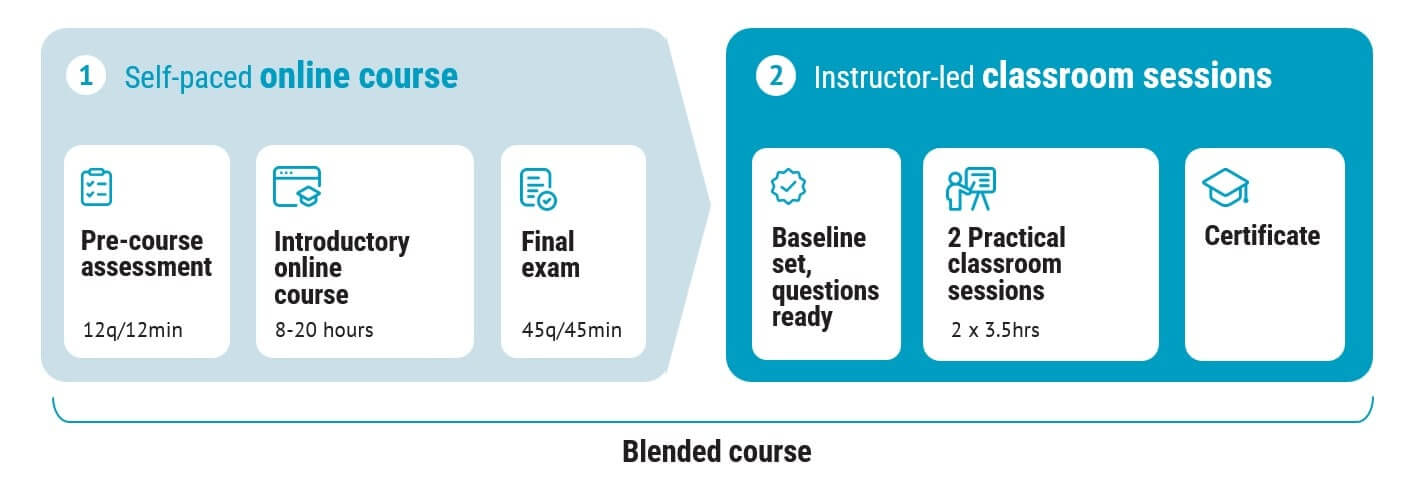
This course consists of two parts:
1. The Safety for Medical Devices and IEC 60601-1 online course
2. Two half-day live virtual classroom sessions held by the course creator
First, you complete the popular safety for medical devices online course. It covers topics such as proactive safety by design, identifying and managing requirements, internal verification, third party test and certification and product maintenance.
You can start the online course immediately and you must successfully complete the final exam prior to the classroom sessions. If you have already completed the online course, you can register for the classroom sessions only.
The unique, highly interactive live virtual classroom sessions are facilitated by Claus Rømer Andersen, who is an expert in this field. During the sessions, you get to apply the theory you have learnt via case studies, workshops, and discussions. There is plenty of time for Q&As, and with a maximum of 8 people per classroom session, all participants have the opportunity to learn first-hand from an industry expert.
A digital course companion is included as well as several time-saving templates.
We recommend this course to those who are working with development or maintenance of an electrical medical device, such as R&D engineers, product specialists, risk management specialists, regulatory specialists and the Quality Assurance department.
Want to know more about our blended courses? Watch the video below.
Our blended learning courses combine the best of both worlds: online training and two half-day live virtual classroom sessions afterwards.
The online training allows for the flexibility in the way you learn, so that you can learn in a way which suits you best. You can access it whenever and wherever you want, and you can stop, start, and repeat the lessons and quizzes as often as you would like. To help maximise your learning, you can check your knowledge and understanding every step of the way by taking the assessment test beforehand, as well as the checkpoint quizzes that are found throughout the course. Ultimately, you will take a final exam at the end of the course.
The classroom sessions are highly interactive and focuses on applying the theory you have learnt during the online course with the guidance of the expert instructor. There are real-life case scenarios to work through and plenty of time for discussions and questions.
Benefits for you
Learn how to develop a safe electrical medical device that meets type approval requirements
The goal is that upon completion of this course, you should be able to understand how to navigate and manage the many requirements of the IEC 60601 series of standards. You should be able to integrate these requirements with the risk management process throughout the design control process.
Direct access to standards authors
Gain exclusive up to the minute information by learning from authors of the standards.
Our courses are developed by members of the standardization committees involved at both national and international levels, ensuring you receive first-hand knowledge and insights.
Interactive instructor engagement
Our instructors are passionate about what they do, bringing their expertise and love for the subject into the learning experience.
Participate in active learning by asking questions directly to the instructor, taking part in group workshops and discussions. This allows you to seek clarification, share insights, apply and transfer knowledge.
Course structure
Online course
The online course comprises a mixture of pre-recorded videos, quizzes, and a final exam. It is self-paced and flexible in that you can start, stop, and repeat as much as you like. You will have lifetime access to the course (conditions apply).
The Safety for Electrical Medical Devices and IEC 60601-1 online course consists of 14 lessons which are outlined below.
- Welcome
- What you need to know
- Set you course completion date
- Pre-course asssessment quiz
- Why consider general safety – and what is it?
- Which types of medical devices are in scope of IEC 60601
- When to address IEC 60601 in the design process
- The changing world of regulatory requirements and standards
- Introduction to the 60601 series of standards
- The general standard
- Relationship with ISO 14971 on risk management
- Basic safety and essential performance
- How to determine which parts are applied parts
- Identifying patient connections
- How to categorise applies parts
- Explanation of means of protection (MOP)
- Where most manufacturers go wrong
- How to integrate with the risk management process – Part 1
- How to integrate with the risk management process – Part 2
- How to manage requirements
- Effective identification of applicable risks and requirements
- Iterative concept development, coupled with safety by design
- Define your documentation architecture – Risk management file records related to safety
- Hazards, risks, test method, test level acceptance criteria
- Systematic review and translation of the standards
- Development of the insulation diagram
- Identifying and managing critical components
- Classifications according to the standard
- Identifying insulation requirements – Part 1
- Identifying insulation requirements – Part 2
- Defining test plans and protocols
- The objective: Safe in NC and SFC
- Critical components vs redundant design
- Power supplies and batteries
- Enclosure material and design (fire encl., IP)
- Indicator lights
- General requirements related to safety
- General requirements related to electromagnetic compatibility
- General requirements related to usability engineering
- Lifecycle managment of software
- Minimum requirements for inhouse testing
- Documentation: records, test plans and test reports
- Confidence in results and conclusions
- On third party testing, accreditation and ‘CB Scheme’
- Selection of laboratory
- Request for quote
- Preparing the documentation
- Pre-testing
- Preparing for test
- Managing the test process
- Evaluating the test results, reports and certificates
- Change control
- Reasons for change
- Impact assessment and gap analysis
- Retesting
- Summary and conclusion
- Final Exam
- Course evaluation
- Learn more in a live virtual class
- The live virtual class product
- Get your questions answered on the live virtual class
Classroom session(s)
You will attend these two half-day live virtual instructor-led classroom sessions via Zoom. The focus is on practicing the new skills, knowledge, and understanding learnt during the online course, in a relaxed environment, with the guidance of an expert instructor. There are real-life case scenarios to work through, and plenty of time for discussions and questions.
The live virtual classes will cover all aspects of the IEC 60601 series of standards, how to identify and manage product specific requirements and how this process is integrated with the design control and risk management processes.
The maximum number of people in a classroom session is 8.
Included is a digital course companion and the following time-saving templates:
- IEC 60601-1 ed. checklist
- Insulation diagram
- List of critical components
- Test protocol
- Test plan
- Essential performance specification
Frequently asked questions
The blended course consists of two parts: the online course, and two half-day live virtual classroom sessions.
The online course is made up of carefully scripted pre-recorded videos in order to maximise your learning. The live virtual classroom sessions are virtual face-to-face sessions where you will be interacting with the instructor and the other course participants via Zoom. You are required to be visible on video when taking the classroom sessions.
Yes, you can.
The time spent on the course varies greatly. If you are a beginner or have very high ambitions, you will typically spend more time on it. If you are already experienced in the field, you will probably finish it more quickly. The online course takes 9-25 hours to finish on average.
You do not have to watch the whole course at once. In fact, you can pause, resume, and replay as often as you like.
The two half-day live virtual classroom sessions take approximately 7 hours in total.
You will receive a course certificate after completing the final exam. The course certificate is available when you log in to your account. Go to “My Courses”, and scroll down. You will find it under “Your Course Certificates”.
After successfully completing the classroom session, you will receive a course certificate covering both the online course and the classroom session by email.
If you wish to buy 3 or more seats, we invite you to reach out using the contact form to discuss discount options. Please note, if there are more than 5 people from your organisation wising to take the course, consider arranging an in-house course. The price will be lower, and the course can be customised to your needs.
If you complete the final exam within 6 months of enrolment, you will have lifetime access to the online course (conditions apply). If you do not, your course access will expire after 6 months.
The maximum number of participants for the live virtual classroom session is 8.
There is no pass/fail score on the exam as such, but you are required to achieve 85% or more on the final exam to be allowed to attend the classroom sessions. The check-point quiz questions that are available during the online course will be a good model of what you will get on the final exam.
If you do not achieve 85%, the final exam can be reset for an administrative fee of 50 EUR, and you can take it again.
If you have already completed the online course and taken the final exam more than 3 weeks prior to the classroom sessions, and regardless of whether you have achieved >85%, we will reset the final exam for you for free.
You will need to retake the final exam by 3pm CET the day before the first classroom session. This is because we insist all participants have the information fresh in their mind in order to maximise the learning experience in the live virtual classroom sessions.
The instructor is an accomplished trainer, consultant, and facilitator in the medical device industry. With a background in electrical engineering, he has worked with regulatory navigation, approval management, device testing throughout his whole career.
He continuously participates in authoring standards such as the IEC 60601-1 and the collateral standards. This ensures he has access to leading-edge knowledge and information, which is the highest qualification available for teaching the course.
We offer a number of payment methods including credit card,
GooglePay, ApplePay, PayPal, wire transfer/invoice depending on the country you
are buying from. If you cannot find your country on the list at checkout or you
are not given wire transfer as a payment method, you can submit your order via
our invoice order
form.
Medical Device HQ is proud to be an accredited CPD provider, demonstrating our commitment to your continued professional development with high-quality training courses.
A CPD record showcases your professional growth, boosts confidence in your abilities, and can be presented to management for better career opportunities.
As a participant of a CPD certified course, you will receive a certificate awarding you CPD points following completion of the training.
Upon completion of this blended course, you are awarded 25 CPD points.
Your course certificate will display the exact number of CPD points. Read more.
Claus Rømer Andersen is an accomplished trainer, consultant and facilitator in the medical device industry. With a background in electrical engineering, he has worked with regulatory navigation, approval management, device testing throughout his whole career.
He is recognized as having a pragmatic and solution oriented approach to helping development teams focus on relevant issues throughout the entire product life-cycle.
Reviews
UNEEG Medical
theDesignLink Limited
